

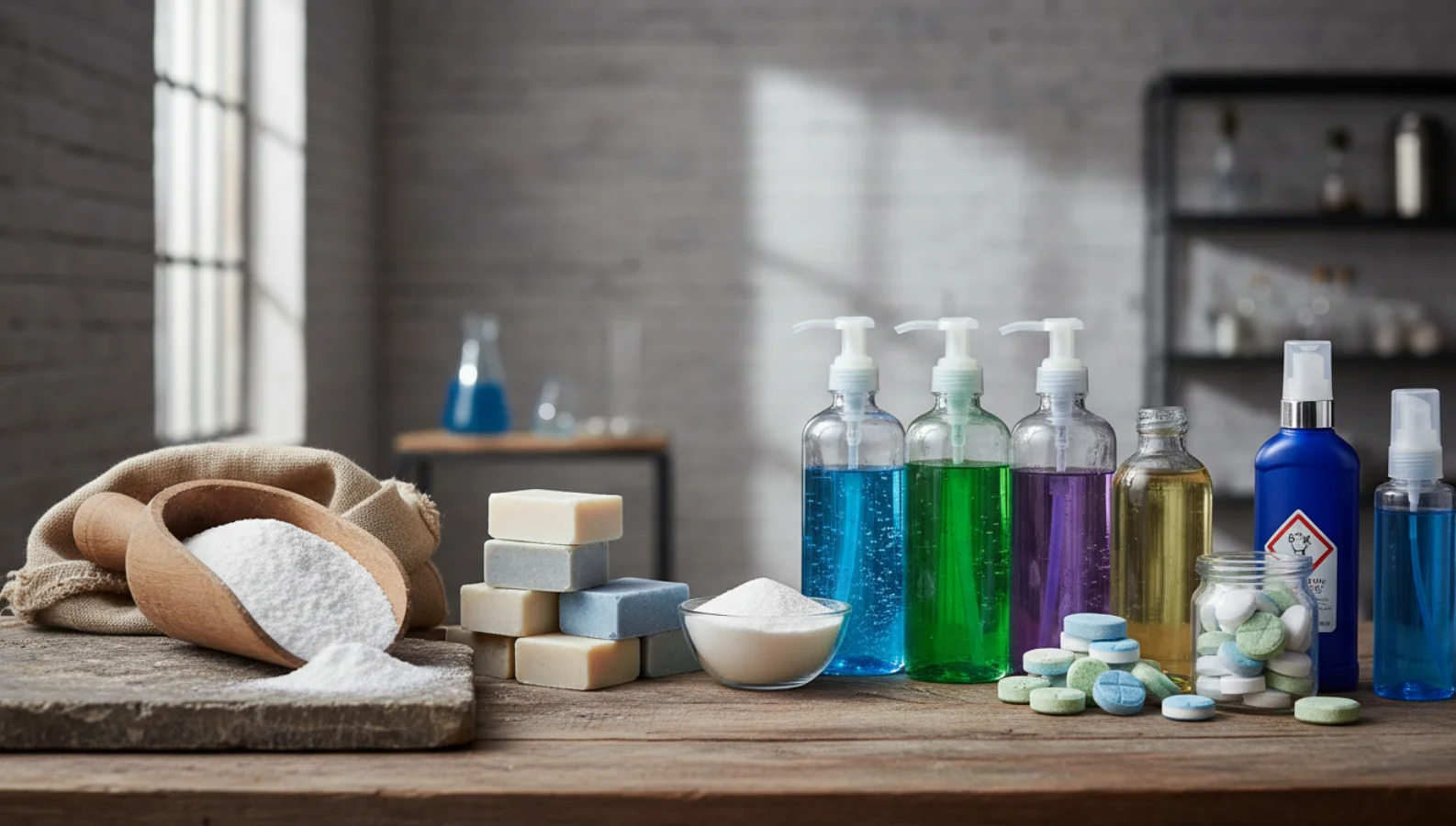
Detergent technology has developed rapidly in the past two decades. Today’s market no longer offers only traditional washing powder; consumers can choose from liquid detergents, laundry bar soap, soap powder, and even specialized products like disinfectant liquids and dishwasher tablets. For both households and brand owners, understanding the strengths of each format is the key to meeting cleaning needs efficiently and cost‑effectively.
This article explains the main differences between detergent formats and how to select the right products for different users and regions.
1. Washing Powder: Classic, Powerful, and Cost-Effective
Washing powder remains one of the most widely used detergent formats in the world, especially in regions such as Africa, the Middle East, South America, and parts of Southeast Asia.
1.1 Advantages of Washing Powder
- High cost performance
Washing powder usually offers the lowest cost per wash. For large families and price-sensitive markets, this is a major advantage. - Ideal for heavy soil
Powders can be formulated with optimized builders and enzymes to tackle mud, dust, and outdoor stains, which are common in many developing markets. - Stable during storage and transport
Compared with liquids, washing powder is less sensitive to temperature and has a longer shelf life—important when exporting to more than 80 countries with different climates.
1.2 When to Choose Washing Powder
Choose powder when:
- Consumers mainly use top-loading machines or semi-automatic machines.
- Water is hard and requires extra builders.
- The market focuses on economy and high volume.
For brand owners, working with a factory that has strong R&D and daily capacity of around 15 containers helps ensure stable supply of both high-foam and low-foam powder for different washing habits.
2. Liquid Detergent: Convenience and Fabric Care
Liquid detergent is growing fast in many regions, especially in urban areas and developed markets.
2.1 Advantages of Liquid Detergent
- Fast dissolving, no residue
Liquid detergent dissolves instantly, reducing the chance of white spots on dark clothes and residues in modern washing machines. - Gentle on fabrics
Many liquid formulas are designed to be less alkaline and more fabric-friendly, making them ideal for colored and delicate garments. - Excellent for cold water washing
In regions where consumers prefer cold water washing to save energy, liquid detergent performs well even at lower temperatures.
2.2 When to Choose Liquid Detergent
Liquid detergent is the best choice when:
- The market has many front-loading or high-efficiency machines.
- Consumers care about color protection and fabric softness.
- You want to position your brand as mid-range or premium.
A manufacturer with a professional research team can develop concentrated liquids that reduce packaging cost and shipping volume while increasing cleaning efficiency.
3. Laundry Bar Soap and Soap Powder: Strong in Hand-Wash Markets
In many countries, laundry bar soap and soap powder still play a key role, especially in rural areas and communities with limited access to washing machines.
3.1 Advantages of Laundry Bar Soap
- Direct stain treatment
Users can scrub collars, cuffs, and heavily soiled areas directly with the bar, achieving strong localized cleaning effects. - Low equipment requirement
Bar soap is ideal where people hand-wash clothes or have no stable electricity. - Simple and familiar format
Many consumers trust soap because it is traditional and easy to understand.
3.2 Soap Powder
Soap powder combines some characteristics of soap and detergent, and can be tailored for different water qualities and washing styles.
3.3 When to Choose Bar Soap and Soap Powder
These formats are suitable when:
- The market has a high rate of hand-washing.
- Consumers prefer visible, tangible products like bars.
- You want to offer low-cost products with strong cleaning for daily wear.
A large-scale factory can adjust bar hardness, shape, fragrance, and foam level, and provide OEM services to match local preferences.
4. Fabric Softener and Disinfectant: Added Value in the Laundry Process
4.1 Fabric Softener
Benefits:
- Makes textiles softer, especially towels and bed linen.
- Reduces static electricity, making clothes easier to iron and wear.
- Keeps fabrics smelling fresh for longer.
Fabric softeners are popular in hotels, hospitals, and high-end home users. Concentrated formulas reduce usage per wash and save space in retail and warehouses.
4.2 Disinfectant Liquid
Usage scenarios:
- Baby clothes and bedding
- Uniforms and workwear in food or medical environments
- Towels and linens shared by multiple people
The key is tested and proven formulas that meet hygiene requirements without damaging fabrics. A manufacturer with complete testing reports and strict quality control can support both household and institutional disinfectant lines.
5. Dishwashing Liquid, Hand Soap, and Dishwashing System Products
5.1 Dishwashing Liquid
- Must provide strong degreasing power for oils and food residues.
- Needs to be gentle on hands, especially in households that wash dishes without gloves.
- For consistent branding, many companies unify fragrance style with their laundry products.
5.2 Hand Soap
Hand soap is crucial for hygiene after handling raw food, cleaning, or laundry. Products should be:
- pH-balanced
- Moisturizing
- Dermatologically tested, when positioned as skin-care friendly
5.3 Dishwasher Salt, Tablets, and Rinse Aid
As dishwashers become more common in urban and developed markets, a complete dishwasher system includes:
- Dishwasher Salt – softens water to improve washing and protect machine parts.
- Tablets – pre-dosed blocks combining detergent, enzymes, and sometimes salt and rinse aid.
- Rinse Aid – supports spot-free, quick-dry glassware and dishes.
For brand owners, offering both laundry and dishwashing lines creates a full home care portfolio and increases shelf presence.
6. Choosing the Right Format for Different Markets
6.1 By Region and Infrastructure
- Africa & parts of South America
High demand for washing powder and laundry bar soap; price sensitivity; variable water quality. - Middle East & Southeast Asia
Mixed demand: powder for traditional users, liquid for modern urban users; growing interest in fabric softener and disinfectant. - United States and other developed markets
Strong growth in liquid detergents, concentrated formulas, dishwasher tablets, and specialized fabric care products.
A factory exporting to more than 80 countries accumulates experience in adapting formulas and packaging to different cultures and usage habits.
6.2 By Target Consumer Group
- Economy segment: washing powder, basic bar soap, standard dishwashing liquid.
- Middle segment: improved powders, standard liquids, softeners, hand soap.
- Premium segment: concentrated liquids, baby-safe and sensitive-skin lines, disinfectant liquids, dishwasher system products.
7. How OEM/ODM Supports Product Strategy
7.1 One-Stop Product Line
A factory with a complete range—washing powder, soap & soap powder, liquid detergent, hand soap, disinfectant, dishwashing liquid, dishwasher salt, tablets and rinse aid—can:
- Supply all key home care categories.
- Simplify procurement and logistics.
- Ensure consistent quality and brand image across products.
7.2 Customization and Processing Services
With strong R&D and flexible facilities, an OEM partner can:
- Develop new formulas based on your market research.
- Use your packaging design and materials.
- Process your raw materials or components.
- Turn customer samples into stable, mass-producible products.
This flexibility makes it easier to quickly adapt to changing market trends while keeping consistent quality and competitive pricing.
8. Conclusion
Each detergent format—washing powder, liquid detergent, laundry bar soap, soap powder, fabric softener, disinfectant, dishwashing products—has its own advantages and best-use scenarios. The “right” product is the one that matches:
- Local washing habits and equipment
- Water quality and climate
- Consumer purchasing power
- Brand positioning and long-term strategy
Working with a large-scale, experienced manufacturer that combines strong factory support, professional R&D, complete product lines, and reliable OEM services allows you to confidently select and develop the most suitable detergent formats for your target market—delivering clean clothes, healthy homes, and sustainable business growth.